If you’re working in New Jersey, one of the first things you notice on your pay stub is how much is taken out for state income tax.
Understanding New Jersey state tax helps you plan your finances, track your deductions, and make sure your paycheck reflects what you actually earn.
Let’s unpack exactly how much state tax comes out of a New Jersey paycheck — and how to estimate your take-home pay accurately.
Understanding New Jersey State Income Tax
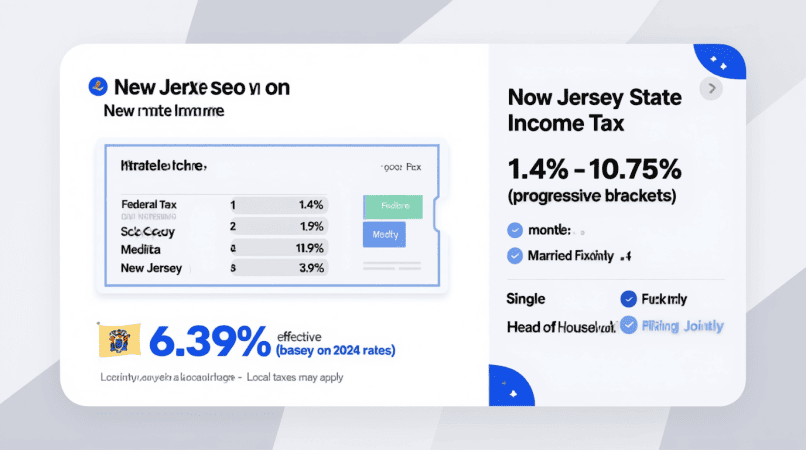
New Jersey uses a progressive income tax system, which means your tax rate increases as your income goes up.
Unlike a flat tax, you only pay higher rates on the portion of your income that falls within each bracket.
State tax is automatically withheld from each paycheck based on the NJ-W4 form you complete when starting a job.
Your employer uses that information — such as your filing status and number of dependents — to determine how much to withhold each pay period.
New Jersey State Income Tax Brackets
The 2025 tax brackets for single filers in New Jersey are:
| Income Range | Tax Rate |
|---|---|
| Up to $20,000 | 1.4% |
| $20,001 – $35,000 | 1.75% |
| $35,001 – $40,000 | 3.5% |
| $40,001 – $75,000 | 5.525% |
| $75,001 – $500,000 | 6.37% |
| $500,001 – $1,000,000 | 8.97% |
| Over $1,000,000 | 10.75% |
If you earn $60,000 per year, your effective tax rate isn’t 5.525% — it’s lower because the first portion of your income is taxed at the smaller rates above.
How Much State Tax Is Taken From a Typical New Jersey Paycheck
Your paycheck’s state tax withholding depends on:
- Gross income
- Filing status (single, married, head of household)
- Allowances claimed on your NJ-W4
- Pay frequency (weekly, biweekly, monthly)
Example: $70,000 Annual Salary, Biweekly Pay
| Category | Amount | Notes |
|---|---|---|
| Gross Pay | $2,692 | $70,000 ÷ 26 pay periods |
| NJ State Income Tax | ~$108 | 4.0% effective rate |
| Federal Income Tax | ~$330 | Based on 2025 brackets |
| FICA (Social Security + Medicare) | ~$206 | Standard 7.65% |
| NJ SUI/TDI/FLI | ~$13 | State insurance programs |
| Net Pay (Take-Home) | ≈ $1,875 | After all deductions |
On average, most workers in New Jersey see 3% to 6% of their paycheck go toward state income tax, depending on income and allowances.
You can calculate a personalized estimate with the New Jersey paycheck calculator.
Other New Jersey Payroll Deductions
State income tax isn’t the only state-level deduction that affects your paycheck.
New Jersey has three additional employee-funded programs:
| Deduction | 2025 Rate | Purpose |
|---|---|---|
| State Unemployment Insurance (SUI) | 0.425% (on first $42,300) | Supports unemployment benefits |
| Temporary Disability Insurance (TDI) | 0.47% | Covers non-work-related illness/injury |
| Family Leave Insurance (FLI) | 0.06% | Provides paid family leave benefits |
Together, these total around 0.9% of most paychecks and appear on your pay stub as small state deductions.
How the NJ-W4 Impacts State Tax Withholding
Your NJ-W4 form plays a big role in how much tax is taken from each paycheck.
If you claim more dependents, less tax is withheld, and you’ll take home more each pay period — but you could owe more at tax time.
If you claim fewer, your paycheck will be smaller, but you’re less likely to owe when filing your return.
You can update your NJ-W4 anytime, especially after big life changes like marriage, a raise, or a new child.
Estimating New Jersey State Tax on Different Pay Frequencies
Your state tax withholding depends on how often you’re paid. Here’s how it looks for a $60,000 salary (single filer, no dependents):
| Pay Frequency | Gross Pay | Approx. NJ Tax Withheld |
|---|---|---|
| Weekly | $1,154 | $45 |
| Biweekly | $2,308 | $90 |
| Monthly | $5,000 | $200 |
These numbers are estimates, but they show how withholding scales with pay frequency.
For personalized results, try the biweekly paycheck calculator.
Tips to Manage or Adjust New Jersey Tax Withholding
You can’t avoid paying state income tax, but you can optimize your withholding to better match your financial goals.
Helpful tips:
- Review your NJ-W4 annually — especially if your income or family status changes.
- Use pre-tax benefits like 401(k), health insurance, or FSAs to lower taxable income.
- Track side income from second jobs or freelance work to avoid underpayment.
- Check your pay stub to ensure the NJ tax amount looks consistent with your income bracket.
Special Situations: Contractors, Overtime, and Bonuses
Independent Contractors (1099 Workers)
Contractors don’t have taxes withheld automatically. You’re responsible for paying:
- New Jersey state income tax
- Self-employment tax (Social Security + Medicare)
You can estimate your true take-home pay using the New Jersey contractor paycheck calculator.
Overtime and Bonuses
Overtime pay is taxed like regular wages.
Bonuses are considered supplemental income and typically withheld at a flat federal rate of 22% plus NJ state tax based on your bracket.
Common Questions About New Jersey Paycheck Taxes
What percentage of my paycheck goes to New Jersey state tax?
Most employees pay between 3% and 6% of their gross pay in state tax, depending on income and dependents.
Does New Jersey have local or city income taxes?
No, there are no city-level income taxes in New Jersey — only state-level tax and insurance deductions.
How can I change my state tax withholding?
Submit an updated NJ-W4 form to your employer to adjust allowances or request additional withholding.
Why did my paycheck get smaller this year?
Tax bracket changes, updated insurance rates, or adjustments to your NJ-W4 can affect your take-home pay.
Do freelancers or contractors pay state tax differently?
Yes, they must make quarterly tax payments directly to the NJ Division of Taxation instead of through employer withholding.
“Use the New Jersey Payroll Tax Calculator to estimate how much state tax is deducted from your paycheck.”
“Check the New Jersey Income Tax Bracket Calculator to find your exact state tax rate.”
“Learn how NJ-W4 Withholding Affects Your Paycheck and your state tax deductions.”
“Compare your net earnings using the New Jersey Gross-to-Net Paycheck Calculator.”
“Understand all New Jersey Paycheck Deductions including income, FICA, and local taxes.”
“See how Federal Tax Withholding and state taxes work together to affect your take-home pay.”
Juanita is the creator behind njpaycheckcalculator.org, dedicated to providing accurate and easy-to-use paycheck calculation tools for New Jersey residents. With a strong focus on clarity and reliability, she helps users understand their paychecks and tax deductions with confidence. Juanita is passionate about simplifying complex financial calculations, empowering users to make informed decisions about their income and budgeting.