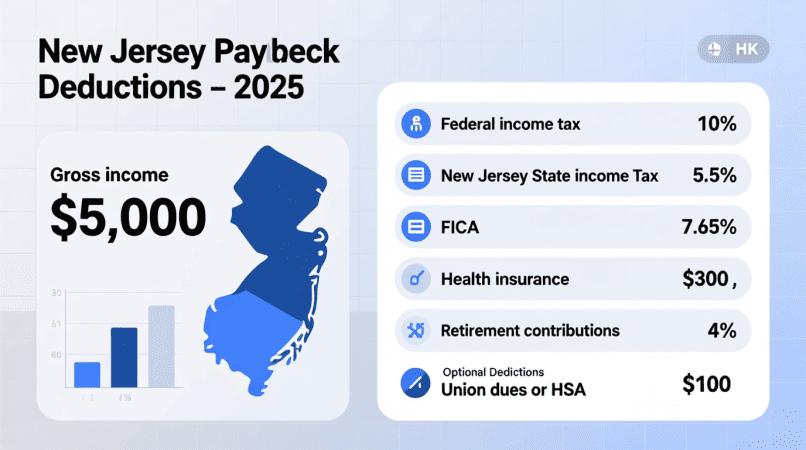
Every time you get paid in New Jersey, a chunk of your earnings goes toward taxes, insurance programs, and benefits.
That’s normal — but it can still be confusing to see your gross pay shrink before it hits your bank account.
So, what exactly comes out of your paycheck in New Jersey? Let’s break down each deduction and what it means for your take-home pay.
Mandatory Deductions Every New Jersey Worker Pays
These are the deductions required by law — they fund federal, state, and insurance programs that support employees across the state.
Federal Income Tax
Your employer withholds federal tax according to your W-4 form, which includes your filing status and the number of dependents you claim.
This money goes straight to the IRS to cover your federal income tax bill.
Social Security and Medicare (FICA)
The Federal Insurance Contributions Act (FICA) covers Social Security and Medicare.
| Type | Employee Rate | Purpose |
|---|---|---|
| Social Security | 6.2% | Provides retirement and disability benefits |
| Medicare | 1.45% | Funds health coverage for seniors |
Your employer matches these contributions, but only your share appears on your pay stub.
New Jersey State Income Tax
New Jersey’s income tax rates range from 1.4% to 10.75%, depending on your annual income.
Your NJ-W4 form determines how much state income tax your employer withholds.
If you want to see the difference that state tax makes, try running your numbers through the New Jersey gross-to-net calculator — it shows what your paycheck looks like before and after taxes.
State Unemployment Insurance (SUI)
SUI helps fund unemployment benefits for workers who lose their jobs.
Most New Jersey employees pay about 0.425% on the first $42,300 in wages (the cap updates annually).
Temporary Disability Insurance (TDI)
TDI funds partial wage replacement for employees unable to work due to illness or non-work-related injury.
In 2025, employees contribute roughly 0.47% of their wages up to the annual limit.
Family Leave Insurance (FLI)
FLI provides paid leave for caring for a new baby or seriously ill family member.
The rate is small — around 0.06% of wages — but it’s a valuable program unique to New Jersey.
Optional and Voluntary Deductions
These deductions depend on your benefits, retirement plans, and financial choices.
They’re not required, but they can have a big effect on your paycheck and your long-term savings.
Health, Dental, and Vision Insurance
If your employer offers insurance, your share of the premium is automatically deducted from your paycheck — usually pre-tax, which helps lower your taxable income.
Retirement Contributions
Many workers contribute to a 401(k), 403(b), or state pension plan.
These are often pre-tax deductions, meaning you’ll pay less in taxes today while saving for retirement.
If you’re comparing salary vs. hourly wages or want to see how contributions impact your paycheck, the salary paycheck calculator can give you a precise breakdown.
Flexible Spending Accounts (FSA) or Health Savings Accounts (HSA)
These accounts let you save money pre-tax for medical or dependent-care expenses, reducing your taxable income.
Union Dues or Professional Fees
Unionized workers may have dues or membership fees deducted from each paycheck.
These amounts depend on the specific union contract or association.
Voluntary Insurance or Charitable Contributions
Some employees opt into additional coverages — like supplemental life or disability insurance — or automatic charitable donations deducted from payroll.
How These Deductions Affect Your Take-Home Pay
Here’s a quick look at how each category typically affects your paycheck:
| Deduction Type | Examples | Tax Impact |
|---|---|---|
| Mandatory | Federal tax, NJ state tax, FICA, SUI, TDI, FLI | Reduces take-home pay immediately |
| Pre-tax | Health insurance, 401(k), FSA | Lowers taxable income |
| Post-tax | Union dues, garnishments, charity donations | Deducted after taxes |
To estimate how much you’ll actually keep after taxes, you can test a few pay scenarios with the biweekly paycheck calculator — especially if your pay frequency or benefits recently changed.
Reading a New Jersey Pay Stub
Every pay stub lists your gross pay, deductions, and net pay.
Typical lines you might see include:
- NJ SUI – State Unemployment Insurance
- NJ TDI – Temporary Disability Insurance
- NJ FLI – Family Leave Insurance
- FED TAX – Federal income tax
- FICA SS – Social Security
- FICA MED – Medicare
- PRETAX MED – Health or dental insurance deductions
If something looks unfamiliar, check your HR portal — or compare it with an example using the New Jersey paystub calculator to see what each line represents.
Special Notes for Contractors and Freelancers
Independent contractors and self-employed workers don’t have these deductions withheld automatically.
Instead, they must pay:
- Self-employment tax (covering both employee and employer FICA)
- Federal income tax
- New Jersey state income tax
If you freelance or do gig work, it’s smart to plan for these payments.
Frequently Asked Questions
1. Why are there so many small deductions on my NJ pay stub?
Programs like disability and family leave insurance are state-specific, which is why New Jersey paychecks include more small deductions than many other states.
2. Are these deductions the same every paycheck?
Most mandatory deductions remain constant, but benefits or retirement contributions can change if you update your coverage or salary.
3. How much do most New Jersey workers lose to taxes and deductions?
Between 20% and 30% of your gross income typically goes to taxes and insurance, depending on your income and benefit setup.
4. Do hourly workers have the same deductions?
Yes, but the amounts vary by hours worked. To estimate, you can use the hourly paycheck tool available on the calculator site.
5. Can I reduce how much is withheld?
You can adjust your NJ-W4 or change pre-tax benefits like 401(k) or health plan contributions to influence your deductions.
“Use our New Jersey Paycheck Deductions Calculator to see every deduction that affects your net pay.”
“Estimate total taxes using the New Jersey Payroll Tax Calculator for both state and federal withholding.”
“Learn more about New Jersey SDI Tax and how it impacts your take-home pay.”
“Understand Family Leave Insurance Tax in New Jersey and how it appears on your paycheck.”
“Check your Gross-to-Net Pay Calculation to see how all deductions reduce your income.”
“Find out What Payroll Taxes Employers Pay in New Jersey in addition to employee deductions.”
Juanita is the creator behind njpaycheckcalculator.org, dedicated to providing accurate and easy-to-use paycheck calculation tools for New Jersey residents. With a strong focus on clarity and reliability, she helps users understand their paychecks and tax deductions with confidence. Juanita is passionate about simplifying complex financial calculations, empowering users to make informed decisions about their income and budgeting.